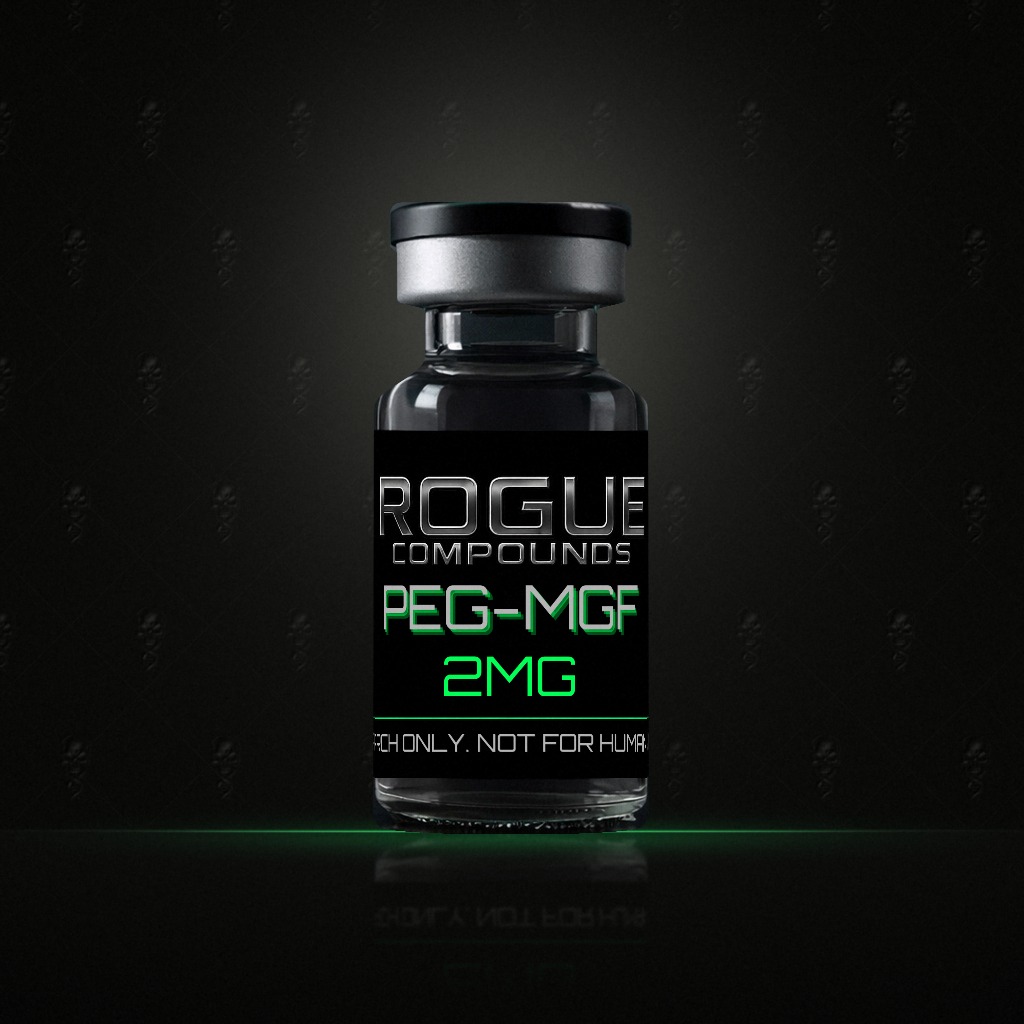
PEG-MGF
PEG-MGF is a synthetic, PEGylated form of mechano growth factor (MGF), a peptide derived from a splice variant of the insulin-like growth factor-1 gene. In humans the variant is called IGF-1Ec, and MGF refers to the distinctive C-terminal E-domain peptide produced by that splicing. Attaching polyethylene glycol (PEG) to the peptide is a standard chemical approach for slowing enzymatic degradation and clearance of short peptides.
Product Specifications
- Product: PEG-MGF
- Amount: See available options above
- Form: Lyophilized powder
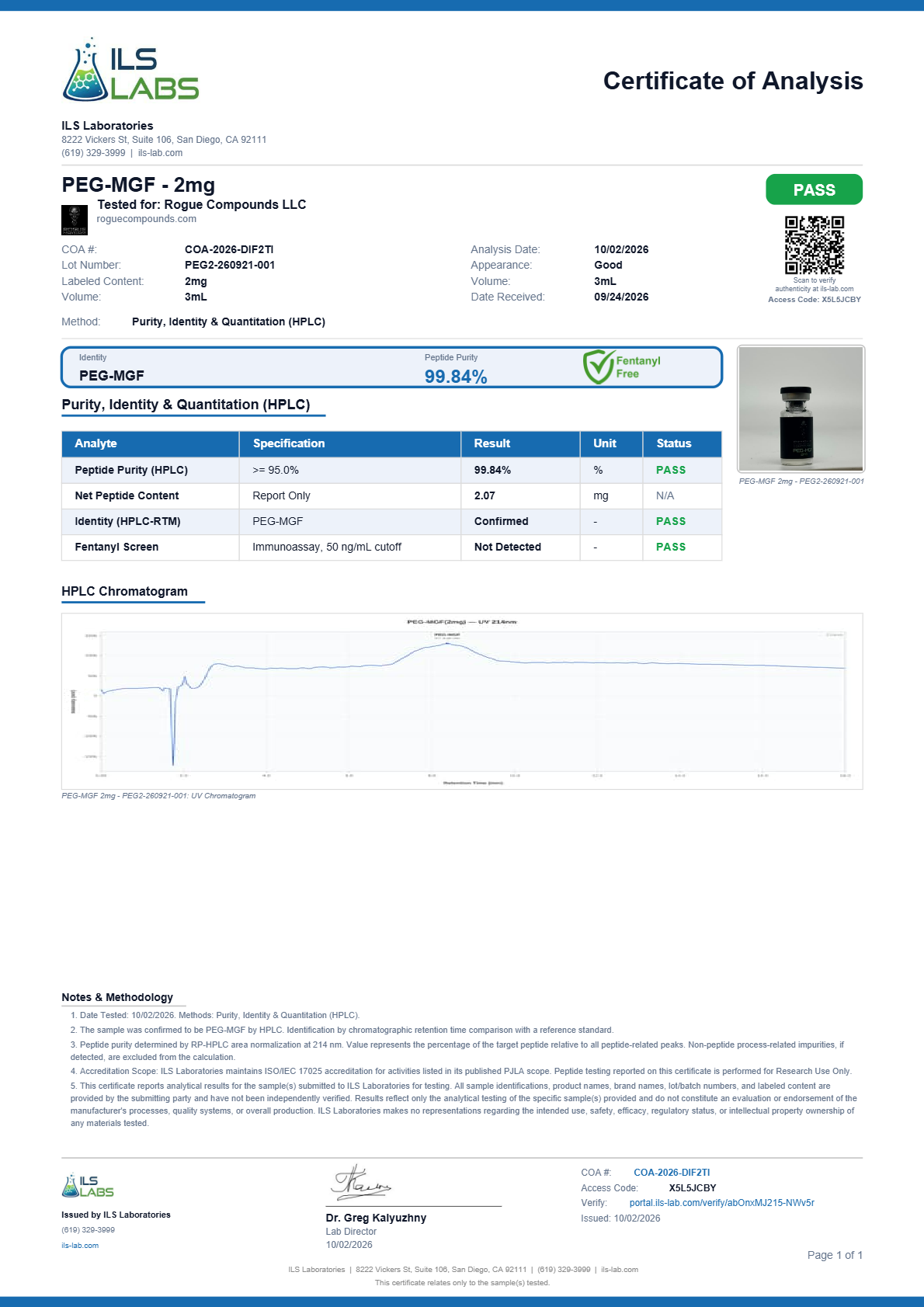
- Purity: Third-party tested by an ISO 17025 U.S. laboratory. See the batch Certificate of Analysis (COA) on this page.
- Storage: Keep sealed and refrigerated at 2–8°C (36–46°F), protected from light.
- Ships from: United States, 2-day UPS
Chemical Profile
- Compound class: PEGylated synthetic peptide derived from the IGF-1Ec (MGF) E-domain
- Note: Peptide sequence, PEG size, molecular weight and other identifiers for this batch are provided on the Certificate of Analysis.
What researchers study
The IGF-1 gene is alternatively spliced to produce several precursor forms that share the mature IGF-1 sequence but differ in their C-terminal E-peptides. Research led by Geoffrey Goldspink’s group in the 1990s reported that one of these splice forms is induced in skeletal muscle after mechanical loading or damage, and named its E-peptide mechano growth factor. Since then, researchers have asked whether the E-peptide has activity of its own, separate from mature IGF-1.
- Splice-variant expression: how IGF-1Ea and IGF-1Ec (rodent IGF-1Eb) transcripts change in muscle, heart, bone and nervous tissue after loading or injury.
- Myoblast and satellite-cell biology: proliferation and differentiation assays in cultured muscle precursor cells, comparing the E-peptide with mature IGF-1.
- Receptor question: whether MGF peptides act through the IGF-1 receptor or another, still unidentified mechanism.
- Peptide stabilization: how PEGylation changes stability and activity of the short E-domain peptide.
The field is unsettled: some laboratories have reported clear effects of synthetic MGF peptides on muscle cells, and others have found none, so findings depend strongly on the peptide form and model system used.
Regulatory status
PEG-MGF is not approved by the FDA for any use, and it has no approved drug equivalent. Mechano growth factors are covered by the World Anti-Doping Agency’s Prohibited List under S2. It is sold here as a research reagent only.
Quality & Documentation
Every batch of PEG-MGF is made in small runs for Rogue Compounds and tested by an independent U.S. laboratory for identity (mass spectrometry) and purity (HPLC). Each vial is labeled with its batch number and a QR code that opens the testing lab’s own report for that batch. The same batch Certificate of Analysis is posted on this page and in our COA Library, so you can check one against the other.
Research overview
For a longer look at PEG-MGF, covering where it came from, what cell and animal studies have measured, and what the evidence does not show, read our PEG-MGF research overview. It is written as background reading, and every study it cites is linked to PubMed.
Selected literature
- Goldspink G. Mechanical signals, IGF-I gene splicing, and muscle adaptation. Physiology (Bethesda). 2005;20:232-8. PMID 16024511
- Yang SY, et al. Different roles of the IGF-I Ec peptide (MGF) and mature IGF-I in myoblast proliferation and differentiation. FEBS Lett. 2002;522(1-3):156-60. PMID 12095637
- Philippou A, et al. Expression of IGF-1 isoforms after exercise-induced muscle damage in humans: characterization of the MGF E peptide actions in vitro. In Vivo. 2009;23(4):567-75. PMID 19567392
- Matheny RW Jr, et al. Minireview: Mechano-growth factor: a putative product of IGF-I gene expression involved in tissue repair and regeneration. Endocrinology. 2010;151(3):865-75. PMID 20130113
- Brisson BK, et al. Insulin-like growth factor-I E-peptide activity is dependent on the IGF-I receptor. PLoS One. 2012;7(9):e45588. PMID 23029120
- Rotwein P. Editorial: the fall of mechanogrowth factor?. Mol Endocrinol. 2014;28(2):155-6. PMID 24460193
Research Use Only
This product is sold strictly as a research chemical for in-vitro laboratory and analytical use by qualified professionals. It is not a drug, dietary supplement, food, or cosmetic, and it is not intended to diagnose, treat, cure, or prevent any disease. Not for human or veterinary use. Rogue Compounds does not provide dosing, preparation, or usage instructions. The literature on this page is listed for scientific background only and does not describe this product or any use of it.