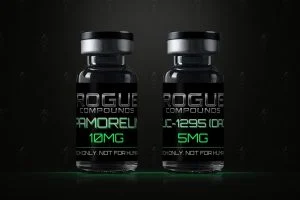

“CJC-1295” is one of the most confusing names in peptide research, because it gets used for two different molecules. CJC-1295 with DAC carries an extra chemical group that lets it latch onto albumin in the blood, so it stays in circulation for days. CJC-1295 without DAC is the same 29-residue backbone with no albumin anchor, and it is cleared within minutes to hours. This guide explains what DAC actually is, how the two versions differ, and what the published studies show for each.
All compounds discussed are sold for laboratory research use only. This page summarizes published research and is not guidance for human or veterinary use.
At a glance
| CJC-1295 without DAC | CJC-1295 with DAC | |
|---|---|---|
| Other names | Modified GRF (1-29), Mod GRF 1-29, tetrasubstituted GRF (1-29) | CJC-1295, CJC-1295 DAC (the original ConjuChem compound) |
| Backbone | GHRH (1-29) with four amino acid substitutions | The same substituted GHRH (1-29), plus a lysine at position 30 |
| Added group | None | Maleimidopropionyl (MPA) group on the lysine side chain, the “Drug Affinity Complex” |
| Size | 29 residues, about 3,368 g/mol | 30 residues plus MPA, about 3,647 g/mol |
| How it stays active | Substitutions slow enzymatic breakdown, but the peptide still circulates freely and clears quickly | Binds covalently to albumin after administration, so it circulates as a large albumin conjugate |
| Reported half-life | Minutes to hours (not well characterized in published human data) | About 6 to 8 days in healthy adults (Teichman et al., 2006) |
| Effect on the GH signal in studies | Short pulse of GHRH receptor activity | Sustained receptor stimulation; GH stays pulsatile but with raised baseline levels |
| Often studied with | Ipamorelin and other GH secretagogues | Usually studied alone |
Where the name confusion comes from
ConjuChem Biotechnologies created CJC-1295 in the early 2000s as a long-acting GHRH analog. The name originally referred to the version with DAC, the albumin-binding design that was the whole point of the project (Jetté et al., 2005). The modified 29-residue peptide underneath it already existed as “Modified GRF (1-29).”
Over time, suppliers started calling Mod GRF (1-29) “CJC-1295 without DAC,” and the shorter name stuck. Wikipedia notes that the two have been “falsely equated in several scientific papers.” The practical result: when you read “CJC-1295” in a paper or on a product page, check which molecule is meant before comparing results. Data from a DAC study does not describe the no-DAC peptide, and the other way around.
The shared backbone: four substitutions
Both versions start from the first 29 amino acids of growth hormone-releasing hormone (GHRH), the shortest fragment that keeps full activity at the GHRH receptor. Native GHRH (1-29) is broken down within minutes, mainly by the enzyme DPP-IV clipping the first two residues. Four substitutions make the fragment more stable:
- Position 2: D-alanine replaces L-alanine, which blocks DPP-IV cleavage
- Position 8: glutamine replaces asparagine, reducing a known breakdown site
- Position 15: alanine replaces glycine, which strengthens the helix that binds the receptor
- Position 27: leucine replaces methionine, removing an oxidation-prone residue
That substituted 29-residue chain is CJC-1295 without DAC. It is more stable than native GHRH (1-29) or sermorelin, but it still circulates as a small free peptide and is cleared quickly.
What DAC actually is
DAC stands for Drug Affinity Complex, ConjuChem’s name for its albumin-binding technology. In CJC-1295 it is a lysine added at position 30, with a maleimidopropionic acid (MPA) group attached to the lysine side chain.
The maleimide group reacts with the free thiol on cysteine-34 of serum albumin, forming a stable covalent bond. Albumin is the most abundant protein in blood and has a half-life of around three weeks, so a peptide anchored to it stays in circulation far longer than it would on its own. In rats, Jetté et al. (2005) showed that the albumin conjugate still activates the GHRH receptor on the pituitary, which is what made the long-acting design possible.
What the studies show for CJC-1295 with DAC
- Half-life in humans: In a study of healthy adults, CJC-1295 had an estimated half-life of about 6 to 8 days, and IGF-I levels stayed raised for more than a week after a single administration (Teichman et al., 2006).
- GH pulses persist: A follow-up study found that GH secretion stayed pulsatile during continuous CJC-1295 stimulation. Baseline (trough) GH rose, but the normal pulse pattern was preserved (Ionescu and Frohman, 2006).
- Growth in knockout mice: In mice lacking their own GHRH, CJC-1295 restored normal growth and body composition (Alba et al., 2006).
- Development stopped: CJC-1295 reached Phase II trials before ConjuChem halted the program. It was never approved as a drug.
What the studies show for CJC-1295 without DAC
Most published work on the no-DAC peptide appears under the names Mod GRF (1-29) or tetrasubstituted GRF, and it is far thinner than the DAC literature. The substitutions are well described in GHRH analog research, but there is little published pharmacokinetic data for this exact peptide in humans. Its research use is mostly as a short-acting GHRH receptor agonist, often combined with a ghrelin-receptor agonist such as ipamorelin to study the two GH-release pathways together. See the CJC-1295 and ipamorelin research overview.
How researchers choose between them
- Studying pulse-like GHRH signaling: CJC-1295 without DAC is the relevant tool, because it gives a short burst of receptor activity that is closer to a natural GHRH pulse.
- Studying sustained GHRH receptor stimulation: CJC-1295 with DAC is the peptide with published human and animal data on days-long activity.
- Pairing with a ghrelin-receptor agonist: most published and catalog pairings use the no-DAC version, so the timing of the two signals lines up.
- Comparing across papers: confirm which molecule each study used. The DAC and no-DAC results are not interchangeable.
What the research does not show
The human data on CJC-1295 with DAC comes from a small number of short studies in healthy adults, and the clinical program was halted before Phase III. There are no long-term safety data. For CJC-1295 without DAC, published human pharmacokinetic data are limited, and many claims made about it online are borrowed from DAC studies. Neither compound is approved for any medical use.
Verify what you’re working with
The DAC and no-DAC versions differ by about 280 g/mol, which mass spectrometry picks up easily. That makes identity testing the simplest way to confirm which CJC-1295 is in a vial. Every Rogue batch is tested by an independent, ISO 17025 accredited U.S. lab, and the QR code on each vial opens that batch’s report on the lab’s own website. See how to read a peptide COA or browse the COA Library.
For a wider comparison that includes sermorelin and tesamorelin, see Sermorelin vs CJC-1295 vs Tesamorelin. Full research overviews: CJC-1295 with DAC and CJC-1295 without DAC.
View CJC-1295 (no DAC) on Rogue Compounds
View CJC-1295 (DAC) on Rogue Compounds
References
- Jetté L, Léger R, Thibaudeau K, et al. Human growth hormone-releasing factor (hGRF)1-29-albumin bioconjugates activate the GRF receptor on the anterior pituitary in rats: identification of CJC-1295 as a long-lasting GRF analog. Endocrinology. 2005;146(7):3052-3058. PMID 15817669
- Teichman SL, Neale A, Lawrence B, et al. Prolonged stimulation of growth hormone (GH) and insulin-like growth factor I secretion by CJC-1295, a long-acting analog of GH-releasing hormone, in healthy adults. J Clin Endocrinol Metab. 2006;91(3):799-805. PMID 16352683
- Ionescu M, Frohman LA. Pulsatile secretion of growth hormone (GH) persists during continuous stimulation by CJC-1295, a long-acting GH-releasing hormone analog. J Clin Endocrinol Metab. 2006;91(12):4792-4797. PMID 17018654
- Alba M, Fintini D, Sagazio A, et al. Once-daily administration of CJC-1295, a long-acting growth hormone-releasing hormone (GHRH) analog, normalizes growth in the GHRH knockout mouse. Am J Physiol Endocrinol Metab. 2006;291(6):E1290-E1294. PMID 16822960
Compounds researchers often order together, 5% off as a set. Every vial ships with its batch COA.
See all research bundles →