
Compound comparison
MOTS-c vs SS-31Two Mitochondrial Peptides Compared
MOTS-c and SS-31 are both called “mitochondrial peptides,” but they come at mitochondria from opposite directions. MOTS-c is a natural peptide encoded inside the mitochondrial genome that signals outward to the rest of the cell. SS-31 is a synthetic peptide designed to travel inward and settle on the inner mitochondrial membrane. This guide compares them side by side and links to the full research overview for each.
All compounds discussed are sold for laboratory research use only. This page summarizes published research and is not guidance for human or veterinary use.
At a glance
| MOTS-c | SS-31 | |
|---|---|---|
| What it is | Natural mitochondrial-derived peptide (MDP) | Synthetic aromatic-cationic tetrapeptide (Szeto-Schiller family) |
| Origin | Encoded in the mitochondrial 12S rRNA gene; described by Pinchas Cohen’s group at USC in 2015 | Developed from opioid peptide chemistry by Hazel Szeto and Peter Schiller; mitochondrial activity reported in the early 2000s |
| Size | 16 residues, 2174.6 g/mol | 4 residues, 639.8 g/mol |
| Sequence | Met-Arg-Trp-Gln-Glu-Met-Gly-Tyr-Ile-Phe-Tyr-Pro-Arg-Lys-Leu-Arg | D-Arg-Dmt-Lys-Phe-NH2 (includes two non-natural features) |
| Direction of action | From mitochondria outward: signals to the cytoplasm and nucleus | From outside inward: collects at the inner mitochondrial membrane |
| Key target | Folate cycle and AMPK; moves into the nucleus under stress | Binds cardiolipin, the lipid that anchors the respiratory chain |
| Main research areas | AMPK and one-carbon metabolism, skeletal muscle insulin signaling, nuclear stress-response genes | Cardiolipin and cytochrome c biophysics, ischemia-reperfusion, oxidative stress, mitochondrial aging |
| Full overview | MOTS-c research | SS-31 research |
Two different ideas about mitochondria
MOTS-c matters to researchers because it suggests mitochondria can send coded messages to the rest of the cell, challenging the assumption that mitochondrial DNA only builds energy machinery. SS-31 matters for the opposite reason: it is a tool for protecting that machinery directly, by shielding a key membrane lipid from damage.
Put simply, MOTS-c is studied as a signal, and SS-31 is studied as a shield.
MOTS-c: a peptide encoded by mitochondria
After humanin was found within a mitochondrial gene, the Cohen laboratory searched the mitochondrial genome for other short coding sequences. One, within the 12S rRNA gene, predicted a 16-amino-acid peptide that was detected in rodent tissues and plasma (Lee et al., 2015).
In cells, MOTS-c reduced flux through the folate cycle, leading to buildup of AICAR, a natural activator of the energy sensor AMPK. In mice, skeletal muscle appeared to be the main target tissue (Lee et al., 2015). A later study found that under metabolic stress, MOTS-c moved into the nucleus and worked with stress-responsive transcription factors such as NRF2 to regulate antioxidant genes (Kim et al., 2018).
Read the full MOTS-c research overview or view MOTS-c.
SS-31: a peptide designed to reach mitochondria
The Szeto-Schiller peptides came out of work on short, enzyme-resistant opioid peptides. Some of them turned out to accumulate in mitochondria, and reordering the residues produced SS-31, which keeps that behavior without meaningful opioid activity (Szeto, 2014). Unlike many mitochondria-targeted compounds, it does not depend on membrane potential, so it can still reach damaged mitochondria.
Birk and colleagues showed that SS-31 binds cardiolipin selectively and inhibits the peroxidase activity of the cytochrome c and cardiolipin complex, an early step in mitochondrial damage. In a rat kidney ischemia-reperfusion model, it was associated with preserved mitochondrial structure and faster ATP recovery (Birk et al., 2013).
Read the full SS-31 research overview or view SS-31.
Where their research overlaps
- Oxidative stress: MOTS-c research includes regulation of antioxidant response genes in the nucleus (Kim et al., 2018). SS-31 research includes protection against oxidative damage in neuronal cell lines (Zhao et al., 2005).
- Aging: Both have been studied in aged mice. MOTS-c in age-related insulin resistance (Lee et al., 2015), and SS-31 in muscle redox state and exercise tolerance (Campbell et al., 2019).
- Skeletal muscle: Muscle is the main in vivo target tissue in MOTS-c research and a key readout in SS-31 aging studies.
How researchers choose between them
- Studying mitochondria-to-nucleus signaling: MOTS-c is the relevant tool, because it is itself a mitochondrial signal.
- Studying AMPK or one-carbon metabolism: MOTS-c, given its published effects on the folate cycle and AICAR.
- Studying the inner membrane, cardiolipin or cytochrome c: SS-31 is the relevant tool, with a well-described biophysical mechanism.
- Studying ischemia-reperfusion injury: SS-31 has the longer record in kidney and heart models.
What the research does not show
For both peptides, much of the foundational work comes from the discovering laboratories and their collaborators. Measuring natural MOTS-c is technically difficult, reported plasma levels vary between studies, and no cell-surface receptor has been identified. In vivo findings for both come mainly from rodents.
Verify what you’re working with
SS-31 contains a non-natural amino acid and a D-amino acid, and MOTS-c is a 16-residue sequence with a strongly charged end. Both are easy to get wrong in synthesis, which is why identity testing matters. Every Rogue batch is tested by an independent U.S. lab, and the QR code on each vial opens that batch’s report on the lab’s own website. See how to read a peptide COA or browse the COA Library.
View MOTS-c on Rogue Compounds
References
- Lee C, et al. Cell Metab. 2015;21(3):443-454. PMID 25738459
- Kim KH, et al. Cell Metab. 2018;28(3):516-524. PMID 29983246
- Birk AV, et al. J Am Soc Nephrol. 2013;24(8):1250-1261. PMID 23813215
- Szeto HH. Br J Pharmacol. 2014;171(8):2029-2050. PMID 24117165
- Zhao K, et al. Biochem Pharmacol. 2005;70(12):1796-1806. PMID 16216225
- Campbell MD, et al. Free Radic Biol Med. 2019;134:268-281. PMID 30597195
Research use only. Rogue Compounds products are sold strictly for laboratory research. They are not for human or veterinary use, and nothing in this article is medical advice. The studies cited here describe published research, not this product or any use of it.
Compounds researchers often order together, 5% off as a set. Every vial ships with its batch COA.
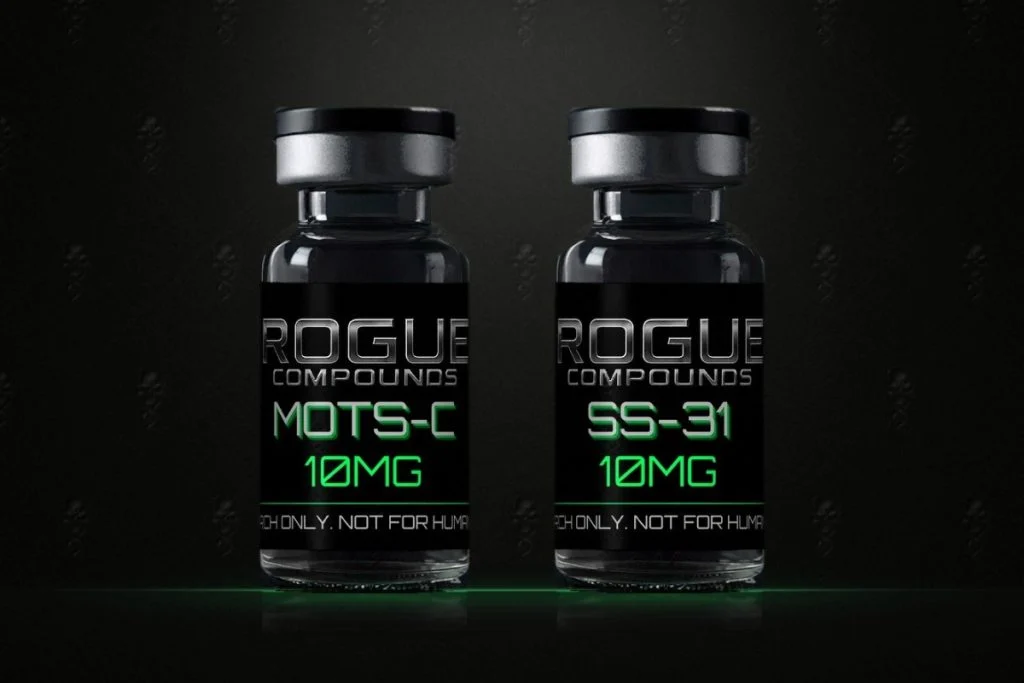 MOTS-c + SS-31From $117.31
 GLP-3 RT + MOTS-c + NAD+From $164.04
 GLP-3 RT + MOTS-cFrom $126.81