

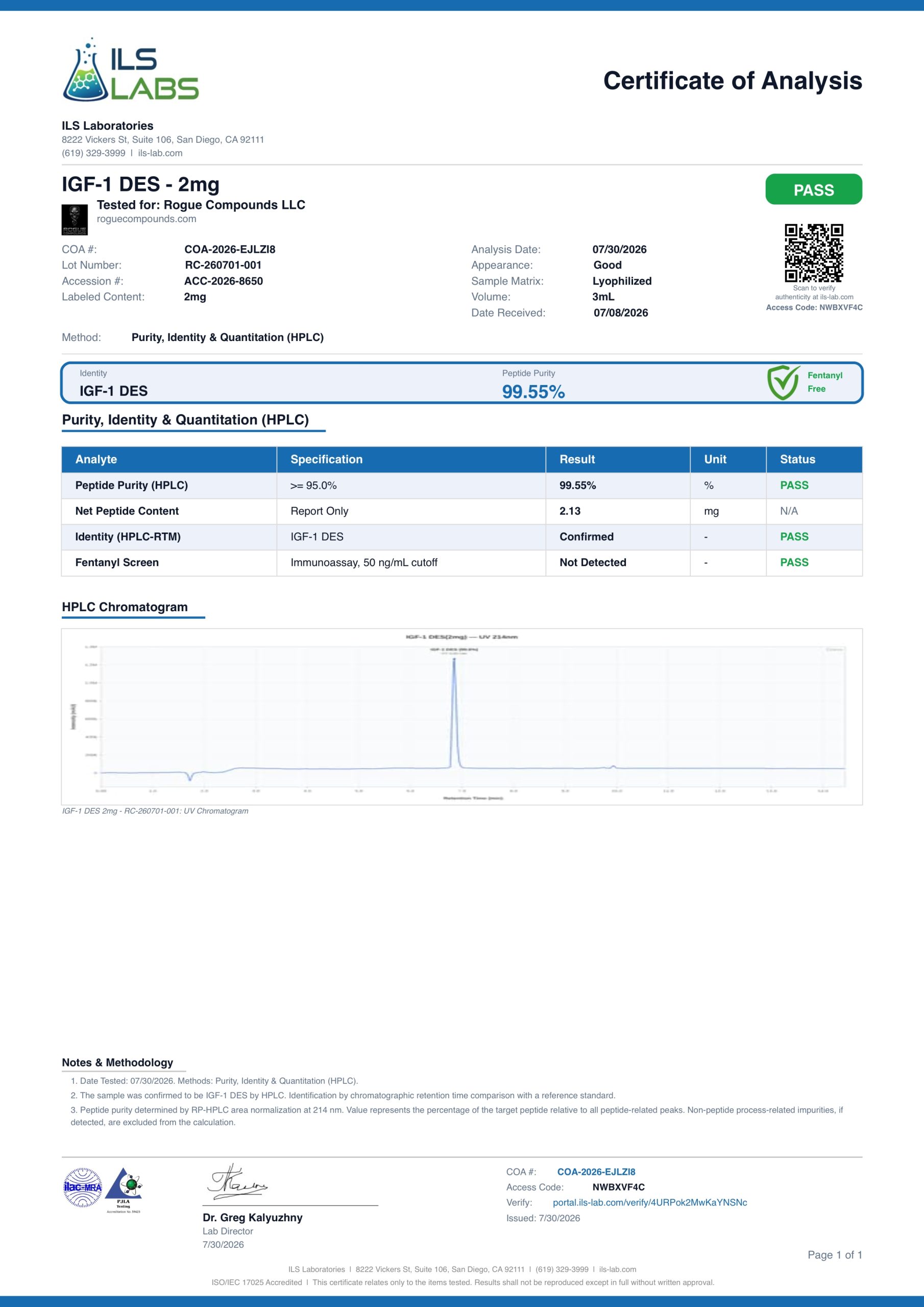
IGF-DES 2mg
Research Overview
IGF-DES (IGF-1 DES 1-3) is a truncated analogue of insulin-like growth factor-1 studied in research models involving IGF-1 receptor signaling, cellular proliferation, tissue regeneration, skeletal muscle physiology, and growth factor biology.
Produced by removing the first three amino acids of native IGF-1, IGF-DES exhibits altered receptor interactions and reduced affinity for insulin-like growth factor binding proteins (IGFBPs). These characteristics have established it as an important research tool for investigating localized IGF-1 signaling and the molecular mechanisms that regulate cellular growth and tissue remodeling.
Lyophilized Vial Format
Precision-manufactured and lyophilized for stability, this research-grade peptide is produced to support reproducible laboratory workflows requiring accurate preparation, controlled storage, and consistent experimental performance.
Why Researchers Study IGF-DES
IGF-DES is investigated for its interaction with the insulin-like growth factor-1 receptor (IGF-1R), a signaling pathway that plays a central role in cellular growth, differentiation, and tissue maintenance. Its modified structure and reduced binding to IGF-binding proteins allow researchers to examine localized IGF signaling with fewer regulatory constraints than native IGF-1.
Its distinct pharmacological profile has made IGF-DES a valuable research peptide for studying growth factor biology, regenerative processes, skeletal muscle physiology, and the complex signaling networks that coordinate cellular adaptation and tissue homeostasis.
Research Applications
Researchers commonly utilize IGF-DES in laboratory investigations involving:
- IGF-1 receptor signaling
- Growth factor biology
- Cellular proliferation
- Cellular differentiation
- Tissue regeneration
- Skeletal muscle physiology
- Regenerative biology
- IGF-binding protein research
- Cellular signaling
- Experimental developmental biology