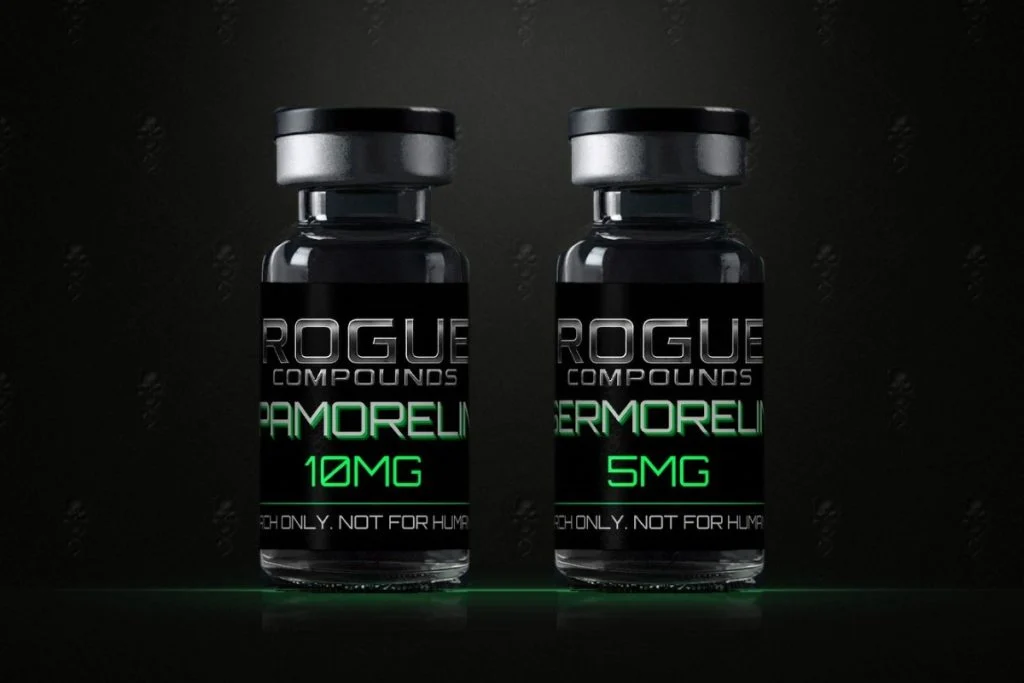
Compound comparison
Sermorelin vs IpamorelinTwo Routes to Growth Hormone Release Compared
Sermorelin and ipamorelin are two of the most compared growth hormone research peptides, and the reason is simple: both cause the pituitary gland to release growth hormone (GH), but they get there through completely different receptors. Sermorelin is a shortened copy of the body’s own GH-releasing hormone (GHRH). Ipamorelin is a small synthetic peptide that acts on the ghrelin receptor. This guide compares their structure, receptors, published research and regulatory history side by side.
All compounds discussed are sold for laboratory research use only. This page summarizes published research and is not guidance for human or veterinary use.
At a glance
| Sermorelin | Ipamorelin | |
|---|---|---|
| Class | GHRH analog | Growth hormone secretagogue (ghrelin receptor agonist) |
| Other names | GRF (1-29) NH2, GHRH (1-29) | — |
| Size | 29 amino acids, about 3,358 g/mol | 5 amino acids, about 712 g/mol |
| Sequence origin | The first 29 residues of human GHRH, the shortest fragment with full activity | Synthetic pentapeptide (Aib-His-D-2-Nal-D-Phe-Lys-NH2), not found in nature |
| Receptor | GHRH receptor on pituitary somatotroph cells | Ghrelin receptor (GHS-R1a), found in the pituitary and hypothalamus |
| Selectivity noted in studies | Acts on the GHRH pathway only | GH release without the cortisol and ACTH increases seen with older secretagogues (Raun et al., 1998) |
Two different routes to the same hormone
GH release from the pituitary is controlled by more than one signal. GHRH from the hypothalamus switches it on, somatostatin switches it off, and ghrelin, a hormone made mostly in the stomach, adds a third input through its own receptor. Sermorelin and ipamorelin each copy one of the “on” signals.
- Sermorelin binds the GHRH receptor, the same receptor the body’s own GHRH uses. Its activity depends on that pathway working normally.
- Ipamorelin binds the ghrelin receptor, first identified in the pituitary and hypothalamus as the target of synthetic GH-releasing peptides (Howard et al., 1996).
Because they use different receptors, the two pathways can act at the same time. That finding is why GHRH analogs and ghrelin-receptor agonists are often studied as a pair.
Sermorelin: a shortened copy of natural GHRH
Human GHRH is a 44-residue peptide, isolated and sequenced in the early 1980s (Ling et al., 1984; Thorner, 2008). Researchers found that the first 29 residues carry the full activity at the receptor, and that fragment, with an amide at the end, is sermorelin. Its receptor was later cloned and characterized in pituitary cells (Mayo, 1992).
The manufacturer discontinued it in 2008, and in 2013 the FDA formally determined that it was not withdrawn for reasons of safety or effectiveness. See the sermorelin research overview.
Ipamorelin: a selective ghrelin-receptor agonist
Ipamorelin came out of 1990s research on growth hormone secretagogues.
In rats, ipamorelin increased longitudinal bone growth (Johansen et al., 1999). It has never been approved as a drug. See the ipamorelin research overview.
Where their research overlaps
- Same end point: both are studied for their effect on GH release from the pituitary, and on IGF-1 downstream of it.
- Both are short-acting: neither has a built-in mechanism to extend circulation, unlike CJC-1295 with DAC. See CJC-1295 with DAC vs without DAC.
- Same anti-doping category: GHRH analogs and GH secretagogues are both on the WADA Prohibited List.
How researchers choose between them
- Studying the ghrelin-receptor pathway: ipamorelin is the more selective tool, with published data showing GH release without the cortisol and ACTH changes seen with older secretagogues.
- Studying both pathways together: because the two receptors act independently, many study designs pair a GHRH analog with a ghrelin-receptor agonist. The most common pairing uses CJC-1295 without DAC; see the CJC-1295 and ipamorelin research overview.
- Comparing GHRH analogs: for how sermorelin stacks up against longer-acting GHRH analogs, see Sermorelin vs CJC-1295 vs Tesamorelin.
What the research does not show
Much of what circulates online comparing them is anecdotal rather than published. Neither compound’s research supports any use outside a laboratory.
Verify what you’re working with
At roughly 3,358 and 712 g/mol, sermorelin and ipamorelin are easy to tell apart by mass spectrometry, which is how identity testing confirms what is in a vial. Every Rogue batch is tested by an independent U.S. lab, and the QR code on each vial opens that batch’s report on the lab’s own website. See how to read a peptide COA or browse the COA Library.
View Sermorelin on Rogue Compounds
View Ipamorelin on Rogue Compounds
References
- Ling N, Esch F, Böhlen P, et al. Proc Natl Acad Sci U S A. 1984;81(14):4302-4306. PMID 6431406
- Thorner MO. J Neuroendocrinol. 2008;20(6):653-654. PMID 18601685
- Mayo KE. Mol Endocrinol. 1992;6(10):1734-1744. PMID 1333056
- Prakash A, Goa KL. BioDrugs. 1999;12(2):139-157. PMID 18031173
- Howard AD, Feighner SD, Cully DF, et al. Science. 1996;273(5277):974-977. PMID 8688086
- Bowers CY, Reynolds GA, Durham D, et al. J Clin Endocrinol Metab. 1990;70(4):975-982. PMID 2108187
- Raun K, Hansen BS, Johansen NL, et al. Eur J Endocrinol. 1998;139(5):552-561. PMID 9849822
- Johansen PB, Nowak J, Skjaerbaek C, et al. Growth Horm IGF Res. 1999;9(2):106-113. PMID 10373343
- Gobburu JV, Agersø H, Jusko WJ, Ynddal L. Pharm Res. 1999;16(9):1412-1416. PMID 10496658
- Beck DE, Sweeney WB, McCarter MD. Int J Colorectal Dis. 2014;29(12):1527-1534. PMID 25331030
Compounds researchers often order together, 5% off as a set. Every vial ships with its batch COA.
See all research bundles →