

Semax and Selank are two short synthetic peptides from the same Russian research program, and they are often mentioned together. Both are seven amino acids long and both end in the same stabilizing Pro-Gly-Pro tail. The difference is where they start: Semax is built on a fragment of the hormone ACTH, while Selank is built on tuftsin, a fragment of immunoglobulin G. This guide compares them side by side and links to the full research overview for each.
All compounds discussed are sold for laboratory research use only. This page summarizes published research and is not guidance for human or veterinary use.
At a glance
| Semax | Selank | |
|---|---|---|
| Parent molecule | ACTH(4-10), a fragment of adrenocorticotropic hormone | Tuftsin, a four-residue fragment of immunoglobulin G |
| Sequence | Met-Glu-His-Phe-Pro-Gly-Pro | Thr-Lys-Pro-Arg-Pro-Gly-Pro |
| Length | 7 residues | 7 residues |
| Molecular weight | 813.9 g/mol (C37H51N9O10S) | 751.9 g/mol (C33H57N11O9) |
| Character of the core | Acidic N-terminal sequence (glutamic acid) | Basic, positively charged core (lysine and arginine) |
| Shared feature | Pro-Gly-Pro C-terminal tail added to slow enzymatic breakdown | |
| Main research areas | BDNF and TrkB signaling, dopamine and serotonin systems, peptide stability, rodent ischemia models | Enkephalinase inhibition, serotonin and dopamine metabolism, hippocampal BDNF expression, GABA-related and immune gene expression |
| Identified receptor | None | None |
| Regulatory status | Not FDA approved; a prescription medicine in Russia | Not FDA approved for any use |
| Full overview | Semax research | Selank research |
A shared design idea
Short natural peptides are usually cut apart by enzymes within minutes, which makes them hard to study. The Moscow laboratories behind both compounds solved this the same way: they kept a short active sequence and added Pro-Gly-Pro to the C-terminus. Proline-rich sequences are poor substrates for many peptidases, so the tail helps the peptide persist longer than its parent fragment.
That shared tail is what makes the pair useful to compare. Effects seen with both peptides may relate to the common Pro-Gly-Pro motif, while differences point back to the ACTH or tuftsin core.
Semax: built on an ACTH fragment
Semax keeps the first four residues of ACTH(4-10) and replaces the rest with Pro-Gly-Pro. It retains none of ACTH’s ability to drive adrenal steroid release, which is why it has been studied mainly as a probe of brain neurochemistry. In rat blood enzyme studies it was still cleaved from the N-terminus, but it persisted longer than the natural fragment (Potaman et al., 1991).
The most cited Semax work involves brain-derived neurotrophic factor (BDNF). Dolotov and colleagues reported specific binding of labeled Semax in rat basal forebrain membranes and higher BDNF protein in that region, then examined BDNF and its receptor TrkB in the rat hippocampus (Dolotov et al., 2006a; 2006b). Rodent neurochemistry studies have also reported shifts in dopamine and serotonin markers (Eremin et al., 2005).
Read the full Semax research overview or view Semax.
Selank: built on tuftsin
Selank keeps the full tuftsin sequence, Thr-Lys-Pro-Arg, and adds Pro-Gly-Pro. Tuftsin was described around 1970 as a peptide that stimulates phagocytosis by immune cells, so Selank has an immune-system ancestry even though it is studied mostly for its effects on brain neurochemistry.
Selank’s research has focused on serotonin and dopamine metabolism in rodents, including a comparison with tuftsin in rats pretreated with the serotonin synthesis inhibitor PCPA and a comparison across two inbred mouse strains (Semenova et al., 2009; Narkevich et al., 2008). Hippocampal BDNF expression has also been measured after intranasal exposure in rats (Inozemtseva et al., 2008), and expression studies have reported changes in GABA-related and inflammatory genes in stress models.
Read the full Selank research overview or view Selank.
Where their research overlaps
- Enzyme inhibition: In a single serum study, both peptides inhibited the enzymes that break down enkephalins, the body’s own opioid peptides (Kost et al., 2001). This means either peptide can affect the stability of other peptides in the same preparation.
- Neurotrophins: Both have been studied for BDNF expression in rat brain tissue, which is a main reason the two are grouped together.
- Monoamines: Both have been measured for effects on dopamine and serotonin markers using HPLC in rodent tissue.
- Direct comparison: A functional connectivity study set the two peptides against each other using imaging methods (Panikratova et al., 2020).
How researchers choose between them
- Studying the ACTH and melanocortin side: Semax is the relevant tool. As a melanocortin fragment, it has also been tested at melanocortin receptors.
- Studying the tuftsin and immune side: Selank keeps the full tuftsin sequence, so it is the relevant tool for questions about how much of a profile is immune rather than neural.
- Separating the tail from the core: Running both peptides in the same model helps show which effects come from the shared Pro-Gly-Pro motif and which come from each core sequence.
What the research does not show
Neither peptide has an identified receptor, so the enzyme, monoamine, BDNF and gene-expression findings remain separate observations rather than a mechanism. Most studies come from a few Russian institutes, many are published in Russian-language journals, and independent replication elsewhere is rare. Rodent studies are typically small and use different routes and models, which makes them hard to compare. No animal or cell result here establishes any effect in people, and none describes the research material sold here.
Verify what you’re working with
Semax and Selank are the same length and share their last three residues, so identity testing is what tells them apart. Every Rogue batch is tested by an independent, ISO 17025 accredited U.S. lab, and the QR code on each vial opens that batch’s report on the lab’s own website. The next Semax batch is in production with our U.S. manufacturer; see where our peptides are made. To check a report yourself, read how to read a peptide COA or browse the COA Library.
References
- Potaman VN, et al. N-terminal degradation of ACTH(4-10) and its synthetic analog semax by the rat blood enzymes. Biochem Biophys Res Commun. 1991;176(2):741-746. PMID 1851003
- Dolotov OV, et al. Semax, an analogue of adrenocorticotropin (4-10), binds specifically and increases levels of brain-derived neurotrophic factor protein in rat basal forebrain. J Neurochem. 2006;97(Suppl 1):82-86. PMID 16635254
- Dolotov OV, et al. Semax, an analog of ACTH(4-10) with cognitive effects, regulates BDNF and trkB expression in the rat hippocampus. Brain Res. 2006;1117(1):54-60. PMID 16996037
- Eremin KO, et al. Semax, an ACTH(4-10) analogue with nootropic properties, activates dopaminergic and serotoninergic brain systems in rodents. Neurochem Res. 2005;30(12):1493-1500. PMID 16362768
- Kost NV, et al. Semax and selank inhibit the enkephalin-degrading enzymes from human serum. Bioorg Khim. 2001;27(3):180-183. PMID 11443939
- Narkevich VB, et al. Effects of heptapeptide selank on the content of monoamines and their metabolites in the brain of BALB/C and C57Bl/6 mice: a comparative study. Eksp Klin Farmakol. 2008;71(5):8-12. PMID 19093364
- Inozemtseva LS, et al. Intranasal administration of the peptide Selank regulates BDNF expression in the rat hippocampus in vivo. Dokl Biol Sci. 2008;421:241-243. PMID 18841804
- Semenova TP, et al. Comparison of the effects of selank and tuftsin on the metabolism of serotonin in the brain of rats pretreated with PCPA. Eksp Klin Farmakol. 2009;72(4):6-8. PMID 19803361
- Panikratova YR, et al. Functional connectomic approach to studying Selank and Semax effects. Dokl Biol Sci. 2020;490(1):9-11. PMID 32342318
Research use only. Rogue Compounds products are sold strictly for laboratory research. They are not for human or veterinary use, and nothing in this article is medical advice. The studies cited here describe published research, not this product or any use of it.
Compounds researchers often order together, 5% off as a set. Every vial ships with its batch COA.
 SEMAX + SELANK + PINEALONFrom $151.05
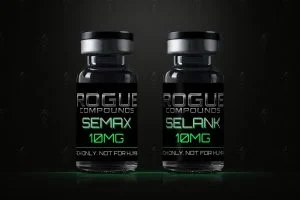 SEMAX + SELANKFrom $104.50
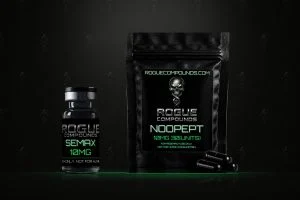 SEMAX + NOOPEPTFrom $90.25