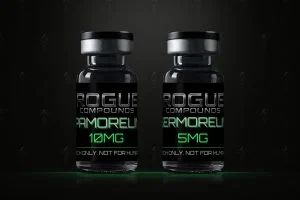
Sermorelin, CJC-1295 (with and without DAC) and tesamorelin are all synthetic analogs of growth hormone-releasing hormone (GHRH). They act on the same receptor, but small changes to their structure give them very different stability and duration in research models. This guide compares them side by side and links to the full research overview for each.
All compounds discussed are sold for laboratory research use only. This page summarizes published research and is not guidance for human or veterinary use.
At a glance
| Sermorelin | CJC-1295 (no DAC) | CJC-1295 (with DAC) | Tesamorelin | |
|---|---|---|---|---|
| Based on | GHRH(1-29), the shortest fully active fragment of native GHRH | GHRH(1-29) with four amino acid substitutions | The same modified GHRH(1-29), plus an albumin-binding group | Full-length GHRH(1-44) |
| Length | 29 residues | 29 residues | 30 residues (extra lysine carrying the DAC linker) | 44 residues |
| Key modification | None (native sequence, C-terminal amide) | D-Ala2, Gln8, Ala15, Leu27 to resist enzymatic breakdown and oxidation | Maleimide “Drug Affinity Complex” that bonds covalently to circulating albumin | Trans-3-hexenoyl cap on the N-terminal tyrosine |
| Duration in research models | Very short (minutes) | Short, but longer than sermorelin | Long, measured in days in human pharmacology studies | Short (a free peptide, not albumin-bound) |
| Developed by | Derived from the GHRH sequence first characterized in 1982 to 1984 | Described in ConjuChem’s work on GRF(1-29) analogs (Jetté et al., 2005) | ConjuChem, Montreal (Jetté et al., 2005) | Theratechnologies (code TH9507) |
| Full overview | Sermorelin research | CJC-1295 no DAC research | CJC-1295 DAC research | Tesamorelin research |
The shared starting point: GHRH
All four compounds start from GHRH, the hypothalamic hormone that signals pituitary somatotroph cells through the GHRH receptor. Researchers discovered early on that the first 29 amino acids, GHRH(1-29), carry essentially all of the hormone’s receptor activity. That fragment, with an amidated C-terminus, is sermorelin, and it became the reference ligand that newer analogs are measured against.
The problem with GHRH(1-29) as a research tool is stability. Dipeptidyl peptidase-4 cleaves off the first two residues and inactivates it, asparagine at position 8 can deamidate, and methionine at position 27 can oxidize. Every analog on this page is, in one way or another, an answer to that problem.
Sermorelin: the reference fragment
Sermorelin is the unmodified GHRH(1-29) amide. Because it matches the native sequence, it is the cleanest tool for studying GHRH receptor activation, cAMP signaling and structure-activity relationships. Its short duration means results depend heavily on experimental timing, and findings from long-acting analogs cannot be assumed to apply to it. A sermorelin drug product was previously approved in the United States and was discontinued in 2008.
Read the full sermorelin research overview or view Sermorelin.
CJC-1295 without DAC: a stabilized fragment
CJC-1295 without DAC, often called Modified GRF(1-29), keeps sermorelin’s 29-residue length but swaps four positions. D-alanine at position 2 blocks dipeptidyl peptidase-4 cleavage, glutamine at position 8 removes the deamidation site, alanine at position 15 improves receptor binding, and leucine at position 27 removes the oxidation-prone methionine. It is still a free peptide that does not bind albumin, so it clears much faster than the DAC version.
Read the full CJC-1295 no DAC overview or view CJC-1295 (no DAC).
CJC-1295 with DAC: built to last
In 2005, Jetté and colleagues at ConjuChem attached a maleimide-containing linker to the modified GRF(1-29) backbone so it would bond covalently to circulating albumin. They called the approach Drug Affinity Complex (DAC). Riding on albumin, the peptide is protected from rapid clearance. In healthy adults, Teichman and colleagues (2006) documented a long half-life and prolonged GH and IGF-1 responses, and Ionescu and Frohman (2006) found that GH pulses persisted during this continuous stimulation, with raised levels between pulses.
Read the full CJC-1295 DAC overview or view CJC-1295 (with DAC).
Tesamorelin: the full-length analog
Tesamorelin takes the opposite approach to the fragments above. It keeps all 44 amino acids of native GHRH and adds a single trans-3-hexenoyl group to the N-terminal tyrosine, which protects that end of the molecule from enzymatic cleavage. Developed by Theratechnologies as TH9507, it is the most extensively studied of the four in clinical research and has an approved prescription drug product in the United States. Research-grade material is a separate product sold only for laboratory use.
Read the full tesamorelin overview or view Tesamorelin.
How researchers choose between them
- Studying the native receptor response: sermorelin is the reference, because its sequence matches natural GHRH(1-29).
- Studying a fragment with better stability: CJC-1295 without DAC keeps the short-acting profile while resisting the main breakdown routes.
- Studying sustained, long-duration stimulation: CJC-1295 with DAC is the albumin-binding option documented in human pharmacology studies.
- Studying the full-length hormone: tesamorelin keeps every residue of GHRH(1-44), so it is the reference for questions about the C-terminal region.
CJC-1295 without DAC is also commonly studied alongside ipamorelin, which acts on a different receptor (the ghrelin receptor). See our CJC-1295 and ipamorelin research overview or the CJC-1295 (no DAC) + Ipamorelin blend.
What the research does not show
None of these compounds has been shown in adequately sized controlled studies to deliver the effects often claimed for them online. Duration and structure differ, but that does not make one “stronger” or “better” outside a specific research question. Because GHRH analogs are prohibited in sport, all four are also targets for anti-doping detection methods.
Verify what you’re working with
Small structural differences are exactly why identity testing matters: CJC-1295 with and without DAC differ by one residue and a linker. Every Rogue batch is tested by an independent, ISO 17025 accredited U.S. lab, and the QR code on each vial opens that batch’s report on the lab’s own website. See how to read a peptide COA or browse the COA Library.
Part of our growth hormone research hub, which compares every GHRH analog and ipamorelin side by side.
View Sermorelin on Rogue Compounds
References
Full reference lists, with links to the original studies, are in each compound’s research overview linked above. Key studies discussed here:
- Ling N, et al. Isolation and characterization of hypothalamic GHRH (1984). See the sermorelin overview.
- Jetté L, et al. Development of long-acting GRF(1-29) analogs using the Drug Affinity Complex approach (2005). See the CJC-1295 DAC overview.
- Teichman SL, et al. Prolonged stimulation of growth hormone and IGF-I secretion by CJC-1295 in healthy adults. J Clin Endocrinol Metab (2006).
- Ionescu M, Frohman LA. Pulsatile secretion of growth hormone persists during continuous stimulation by CJC-1295. J Clin Endocrinol Metab (2006).
- Ferdinandi ES, et al. Non-clinical pharmacology and safety evaluation of TH9507 (2007). See the tesamorelin overview.
Research use only. Rogue Compounds products are sold strictly for laboratory research. They are not for human or veterinary use, and nothing in this article is medical advice. The studies cited here describe published research, not this product or any use of it.
Compounds researchers often order together, 5% off as a set. Every vial ships with its batch COA.
See all research bundles →