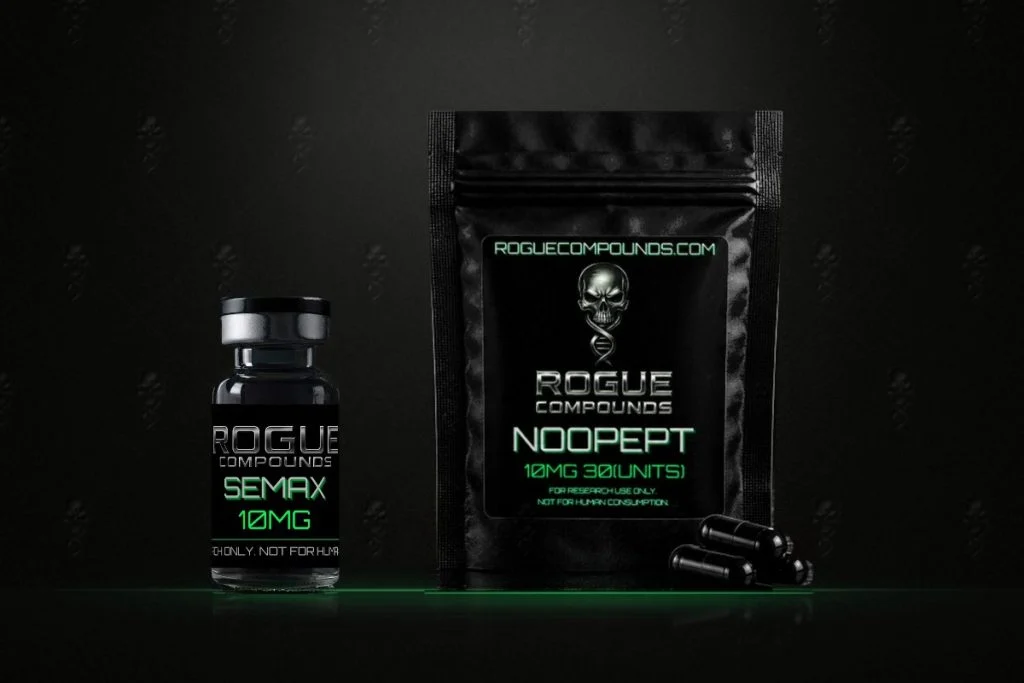
Research overview
What Is Noopept?GVS-111 Research Overview
Noopept (N-phenylacetyl-L-prolylglycine ethyl ester, also called GVS-111 or omberacetam) is a synthetic dipeptide developed in Russia in the 1990s as a peptide analog of piracetam, the original racetam cognition enhancer. Unlike most compounds in the Rogue Compounds research library, it is small enough to be studied orally, and most of its published research comes from a single research institute in Moscow. This overview covers its structure, what the published research has measured, what that research does not show, and its regulatory status.
Noopept is sold for laboratory research use only. This page summarizes published research and is not guidance for human or veterinary use.
Rogue Compounds carries NOOPEPT: current batch tested Aug 12, 2026 by Vanguard Laboratory, identity and quantity verified. View NOOPEPT → · Noopept buying guide
At a glance
- Class: Synthetic N-acylprolyl dipeptide; peptide analog of piracetam
- Origin: Designed at the Zakusov Institute of Pharmacology, Moscow, in the 1990s
- Structure: N-phenylacetyl-L-prolylglycine ethyl ester; C17H22N2O4; 318.4 g/mol; CAS 157115-85-0
- Main research areas: Memory and learning models in rodents, neuroprotection in cell models, pharmacokinetics and active metabolites, transcription factor signaling
- Regulatory status: Research chemical, not for human use
Structure and origin
Noopept was designed by its developers as a peptide counterpart to piracetam. It is a dipeptide (proline and glycine) with a phenylacetyl group on one end and an ethyl ester on the other.
Mechanism: what the research shows
Noopept’s mechanism is still not fully worked out, and several pathways have been proposed:
- Active metabolite: in rats, noopept is converted to cyclo-L-prolylglycine (cycloprolylglycine), a compound that also occurs naturally in the brain. The metabolite has different pharmacokinetics from noopept but a similar profile of effects in memory models, so it may account for part of noopept’s activity (Boyko et al., 2018).
- HIF-1 signaling: in cell studies, noopept increased the DNA-binding activity of the transcription factor HIF-1 without affecting the other transcription factors tested, including CREB, NF-κB and p53 (Vakhitova et al., 2016). A later study linked this to inhibition of the enzyme that normally breaks down HIF-1α (Zainullina et al., 2020).
- Neuroprotection in cell models: in PC12 cells exposed to a toxic beta-amyloid fragment, noopept pretreatment improved cell viability and reduced oxidative stress, calcium overload and tau phosphorylation (Ostrovskaya et al., 2014).
Key areas of study
Memory and learning in rodents
Most noopept research uses rodent memory and learning tasks. Oral noopept showed antiamnesic activity in a passive avoidance task and stimulated one-session learning in an active avoidance model (Ostrovskaya et al., 2001).
Pharmacokinetics and metabolism
Rat studies tracked noopept and its metabolite cycloprolylglycine in plasma and brain, finding that the two compounds behave very differently in the body (Boyko et al., 2018).
Product quality in the supplement market
A 2021 U.S. study tested cognitive-enhancement supplements and found omberacetam (noopept) alongside other unapproved drugs. Several labels listed ingredients that were not detected, products contained ingredients that were not declared, and 75% of the declared quantities were inaccurate (Cohen et al., 2021). That study is a strong argument for independent identity and purity testing of any noopept used in research.
What the evidence does not show
- Most published research comes from one institute in Moscow, and independent replication by other groups is limited.
- How much of noopept’s activity comes from the parent compound versus its metabolite is not settled.
- Cell and rodent findings cannot be assumed to apply to humans.
Regulatory status
Rogue Compounds sells this material as a research chemical, not for human use. It is sold for laboratory research only.
Handling and storage in the lab
Keep the capsules sealed in their original container in a cool, dry place, away from heat, moisture and light.
Sourcing and documentation
Noopept is made in small batches for Rogue Compounds. The batch COA is posted on the product page and in the COA Library. Our guide on how to read a peptide COA explains what to check.
Related research: Semax · Selank
View Noopept on Rogue Compounds
Frequently asked questions
What is Noopept?
Noopept (N-phenylacetyl-L-prolylglycine ethyl ester, also called GVS-111 or omberacetam) is a synthetic dipeptide developed as a peptide analog of piracetam. It is sold for laboratory research use only.
Is Noopept a racetam?
Not structurally. It was designed as a peptide analog of piracetam and is often grouped with the racetams, but it is a dipeptide rather than a pyrrolidone-based racetam.
What is Noopept’s active metabolite?
In rats, noopept is converted to cyclo-L-prolylglycine (cycloprolylglycine), which has its own activity in memory models.
Is Noopept for human use?
No. Noopept is a research chemical, not for human use. It is sold for laboratory research only.
Why does testing matter for Noopept?
A 2021 study of cognitive-enhancement supplements found undeclared ingredients and inaccurate labeled amounts in most products tested. Independent identity and purity testing is the only way to confirm what a sample contains.
References
- Ostrovskaya RU, et al. Bull Exp Biol Med. 2001;132(4):959-962. PMID 11782792
- Neznamov GG, et al. Neurosci Behav Physiol. 2009;39(3):311-321. PMID 19234797
- Ostrovskaya RU, et al. J Biomed Sci. 2014;21(1):74. PMID 25096780
- Vakhitova YV, et al. Acta Naturae. 2016;8(1):82-89. PMID 27099787
- Boyko SS, et al. Biomed Khim. 2018;64(5):455-458. PMID 30378564
- Zainullina LF, et al. Dokl Biochem Biophys. 2020;494(1):256-260. PMID 33119829
- Cohen PA, et al. Neurol Clin Pract. 2021;11(3):e303-e307. PMID 34484905
Research use only. Rogue Compounds products are sold strictly for laboratory research. They are not for human or veterinary use, and nothing in this article is medical advice. The studies cited here describe published research, not this product or any use of it.
Compounds researchers often order together, 5% off as a set. Every vial ships with its batch COA.
See all research bundles →