Research overview
What Is AOD-9604?
AOD-9604 is a synthetic 16-amino-acid peptide modeled on the C-terminal end of human growth hormone. It copies hGH residues 177-191, adds a tyrosine at the N-terminus, and keeps the disulfide bridge that closes the native sequence into a small loop. It came out of Australian research on what was called the lipolytic domain of growth hormone.
Its literature therefore includes both rodent metabolic studies and analytical work from anti-doping science. This overview covers the design of the peptide, the hypotheses about how it acts, the main model systems, and the specific weaknesses of the evidence.
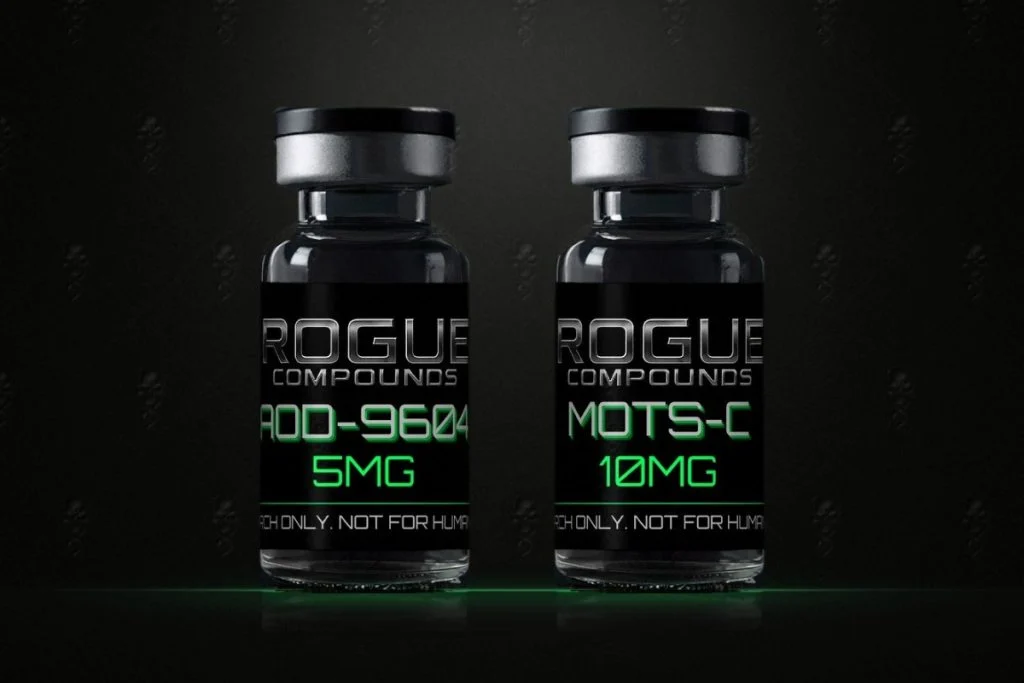
Rogue Compounds carries AOD-9604: current batch tested Aug 15, 2026 by ILS Laboratories, HPLC purity 99.43%. View AOD-9604 →
At a glance
- Class: Synthetic peptide; modified hGH(177-191) analog
- Origin: Developed in Australia from C-terminal hGH peptide research led by Frank Ng; metabolic studies published from 2000
- Structure: Tyr-Leu-Arg-Ile-Val-Gln-Cys-Arg-Ser-Val-Glu-Gly-Ser-Cys-Gly-Phe, disulfide Cys7-Cys14; C78H123N23O23S2; 1815.1 g/mol; CAS 221231-10-3
- Main research areas: adipose tissue lipid metabolism in rodents, β3-adrenergic signaling, separation from GH receptor activity, metabolism and detection
- Regulatory status: Research chemical, not for human use
Structure and origin
The starting point was a series of experiments with synthetic pieces of growth hormone. Those findings suggested that a short sequence near the C-terminus might carry some of GH’s metabolic activity on its own.
AOD-9604 was designed as an optimized version of that sequence. The native residue at position 176 is phenylalanine; AOD-9604 places a tyrosine in front of residue 177 instead. In the numbering of the peptide itself, the two cysteines sit at positions 7 and 14 and form an intramolecular disulfide. That loop corresponds to the Cys182-Cys189 bond in full-length hGH, one of the hormone’s two disulfides. The peptide is otherwise made of standard L-amino acids.
Ng and colleagues described the peptide as a synthetic lipolytic domain of hGH and reported its metabolic effects in rodent studies in 2000 (Ng et al., 2000).
Mechanism: what the research shows
Full-length GH binds the GH receptor and signals through JAK2 and STAT5, raising IGF-1. A central question for AOD-9604 was whether it does any of that. The developers reported that the peptide affected adipose tissue lipid handling without behaving like intact GH in growth-related readouts, which is why it is framed as a tool for separating metabolic from growth-related activity (Ng et al., 2000).
The most detailed mechanistic study used two mouse models. They measured lipolysis and lipogenesis in isolated adipose tissue and the expression of β3-adrenergic receptors (Heffernan et al., 2001a). The differences between normal and knockout animals were interpreted as evidence that the β3 pathway contributes to the peptide’s effects.
No receptor that binds AOD-9604 directly has been identified, so these findings describe downstream associations rather than a defined molecular target.
Key areas of study
Lipid metabolism in rodent adipose tissue
Comparisons with intact hGH run through these studies (Ng et al., 2000; Heffernan et al., 2001a).
Adrenergic receptor involvement
The β3-adrenergic receptor knockout model is the main tool used to connect AOD-9604 to a known signaling pathway, and it remains the most cited mechanistic experiment for the peptide (Heffernan et al., 2001a).
Metabolism and detection
Cox and colleagues studied how AOD-9604 is broken down in vitro, identified its metabolites, and developed mass spectrometry methods for detecting the intact peptide and its fragments (Cox et al., 2015). This work supports anti-doping testing and is also useful for anyone verifying peptide identity analytically.
What the evidence does not show
- The mechanistic and metabolic studies come mainly from the developing group in a short period around 2000-2001, and independent replication is limited.
- Rodent adipose tissue depends far more on β3-adrenergic signaling than human fat does, so the central mechanistic model may not translate across species.
- No direct binding target has been found.
- Online descriptions often treat AOD-9604 and HGH Fragment 176-191 as identical. They differ at the N-terminal residue, and studies of one should not be assumed to apply exactly to the other.
Regulatory status
Rogue Compounds sells this material as a research chemical, not for human use. It is sold for laboratory research only.
Handling and storage in the lab
Store lyophilized AOD-9604 sealed and refrigerated at 2–8°C (36–46°F), protected from light.
Sourcing and documentation
Rogue Compounds has AOD-9604 made in small batches. Every vial carries a batch number and a QR code that opens the independent U.S. testing lab’s own report for that batch. The same batch COA appears on the product page and in the COA Library.
View AOD-9604 on Rogue Compounds
References
- Natera SH, Jiang WJ, Ng FM. Biochem Mol Biol Int. 1994;33:1011-1021. PMID 7987248
- Ng FM, et al. Horm Res. 2000;53(6):274-278. PMID 11146367
- Heffernan M, et al. Endocrinology. 2001;142(12):5182-5189. PMID 11713213
- Heffernan MA, et al. Int J Obes Relat Metab Disord. 2001;25(10):1442-1449. PMID 11673763
- Valentino MA, Lin JE, Waldman SA. Clin Pharmacol Ther. 2010;87(6):652-662. PMID 20445536
- Cox HD, et al. Drug Test Anal. 2015;7(1):31-38. PMID 25208511
Research use only. Rogue Compounds products are sold strictly for laboratory research. They are not for human or veterinary use, and nothing in this article is medical advice. The studies cited here describe published research, not this product or any use of it.
Compounds researchers often order together, 5% off as a set. Every vial ships with its batch COA.
See all research bundles →