

AOD-9604 and 5-Amino-1MQ are both studied in mouse models of obesity and fat metabolism, and both come up whenever researchers compare compounds that act on fat tissue. Beyond that, they have almost nothing in common. AOD-9604 is a 16-amino-acid peptide taken from the end of the growth hormone molecule. 5-Amino-1MQ is a small synthetic molecule that blocks an enzyme, nicotinamide N-methyltransferase (NNMT), found mainly in fat. This guide compares them side by side.
All compounds discussed are sold for laboratory research use only. This page summarizes published research and is not guidance for human or veterinary use.
At a glance
| AOD-9604 | 5-Amino-1MQ | |
|---|---|---|
| Class | Synthetic peptide; modified growth hormone fragment | Synthetic small molecule; enzyme inhibitor |
| Based on | Human growth hormone residues 177-191, plus an added tyrosine | A methylquinolinium scaffold built to inhibit NNMT |
| Length / size | 16 amino acids, one disulfide loop | Small molecule, 159.2 g/mol (cation) |
| Proposed mechanism | Effects on fat-cell lipolysis and lipogenesis; no direct receptor identified | Blocks NNMT, raising NAD+ and SAM levels in fat cells |
| Origin | Australian growth hormone research; metabolic studies from 2000 | University of Texas Medical Branch; described 2018 |
| Development history | Went through clinical studies; drug development discontinued | Preclinical only |
| Rogue Compounds format | Lyophilized vial | Capsules |
A peptide and a small molecule
The biggest difference is what kind of compound each one is. AOD-9604 is a peptide: a short chain of amino acids cut from a much larger hormone and held in a loop by a disulfide bond. Like most peptides, it is supplied as a lyophilized powder. 5-Amino-1MQ is a small synthetic molecule built in a chemistry lab to block one specific enzyme. That makes it far smaller and is why it is available as capsules.
The two also differ in how well their mechanisms are understood. 5-Amino-1MQ has a defined molecular target. AOD-9604 does not: no receptor that binds it directly has been identified, so its proposed mechanism is based on downstream measurements in fat tissue.
AOD-9604: the growth hormone fragment
AOD-9604 came out of Australian research on what was called the lipolytic domain of growth hormone. Early work found that a synthetic peptide matching growth hormone residues 177-191 reduced body weight gain and fat mass in obese mice (Natera et al., 1994). AOD-9604 was designed as an optimized version of that sequence, and its metabolic effects in rodents were described in 2000 (Ng et al., 2000).
The most detailed mechanistic study treated obese mice and mice lacking the β3-adrenergic receptor with growth hormone or AOD-9604, then measured fat breakdown and fat formation in isolated adipose tissue. The differences between the two mouse types were read as evidence that the β3 pathway contributes to the peptide’s effects (Heffernan et al., 2001a). A second study reported increased fat oxidation and weight loss in obese mice treated with growth hormone or the fragment (Heffernan et al., 2001b). For more, see the AOD-9604 research overview.
5-Amino-1MQ: the NNMT inhibitor
NNMT drew attention after a 2014 study found it was higher in the fat and liver of obese and diabetic mice, and that knocking it down protected mice against diet-induced obesity (Kraus et al., 2014).
5-Amino-1MQ comes from a 2018 series of selective, membrane-permeable NNMT inhibitors. In cultured fat cells, these inhibitors lowered the NNMT product 1-MNA, raised NAD+ and SAM levels and suppressed fat formation. In diet-induced obese mice, a potent inhibitor reduced body weight, white fat mass and fat-cell size and lowered plasma cholesterol, without changing food intake (Neelakantan et al., 2018). For more, see the 5-Amino-1MQ research overview.
Where their research overlaps
- Fat tissue: both are studied mainly for their effects inside adipose tissue.
- Obese mouse models: both have been tested in obese mice, with fat mass and body weight as key measurements.
- Fat formation: studies of both compounds measured lipogenesis, the process of building new fat in fat cells.
How researchers choose between them
- To study growth hormone’s metabolic signaling separately from its growth effects, AOD-9604 is the relevant compound.
- To study NAD+ and methylation metabolism in fat, 5-Amino-1MQ acts directly on that pathway.
- For a defined molecular target, 5-Amino-1MQ is the clearer tool, since AOD-9604’s direct target is still unknown.
- For a longer research history, AOD-9604 has been studied since the 1990s and went through clinical development.
What the research does not show
There are no studies comparing AOD-9604 and 5-Amino-1MQ head to head or testing them together. AOD-9604’s clinical development was discontinued, and no receptor for it has been identified. 5-Amino-1MQ has no published human data. Neither is approved by the FDA for any use, and mouse findings cannot be assumed to apply to humans.
Verify what you’re working with
The two products are tested differently. AOD-9604 reports show HPLC purity and mass spectrometry identity; capsule reports for 5-Amino-1MQ confirm identity and fill weight. Our guide on how to read a peptide COA walks through both, and every batch we sell is in the COA Library.
View AOD-9604 on Rogue Compounds · View 5-Amino-1MQ Capsules on Rogue Compounds
Frequently asked questions
What is the difference between AOD-9604 and 5-Amino-1MQ?
AOD-9604 is a 16-amino-acid peptide derived from the end of human growth hormone. 5-Amino-1MQ is a small synthetic molecule that blocks the enzyme NNMT. Both are studied in fat tissue, but they act through different pathways.
Is AOD-9604 the same as growth hormone?
No. It is a short fragment based on residues 177-191 of human growth hormone, designed to study the hormone’s metabolic domain separately from the full molecule.
Why is AOD-9604 a vial and 5-Amino-1MQ a capsule?
AOD-9604 is a peptide, supplied as a lyophilized powder like most peptides. 5-Amino-1MQ is a small molecule, which is why it is available in capsule form.
Has either compound been studied in humans?
AOD-9604 went through clinical studies before its drug development was discontinued. 5-Amino-1MQ has no published human trials.
Are AOD-9604 and 5-Amino-1MQ for human use?
No. Rogue Compounds sells both as research chemicals, not for human use. They are for laboratory research only.
References
- Natera SH, Jiang WJ, Ng FM. Reduction of cumulative body weight gain and adipose tissue mass in obese mice: response to chronic treatment with synthetic hGH 177-191 peptide. Biochem Mol Biol Int. 1994;33:1011-1021. PMID 7987248
- Ng FM, et al. Metabolic studies of a synthetic lipolytic domain (AOD9604) of human growth hormone. Horm Res. 2000;53(6):274-278. PMID 11146367
- Heffernan M, et al. The effects of human GH and its lipolytic fragment (AOD9604) on lipid metabolism following chronic treatment in obese mice and β3-AR knock-out mice. Endocrinology. 2001;142(12):5182-5189. PMID 11713213
- Heffernan MA, et al. Increase of fat oxidation and weight loss in obese mice caused by chronic treatment with human growth hormone or a modified C-terminal fragment. Int J Obes Relat Metab Disord. 2001;25(10):1442-1449. PMID 11673763
- Kraus D, et al. Nicotinamide N-methyltransferase knockdown protects against diet-induced obesity. Nature. 2014;508(7495):258-262. PMID 24717514
- Neelakantan H, et al. Selective and membrane-permeable small molecule inhibitors of nicotinamide N-methyltransferase reverse high fat diet-induced obesity in mice. Biochem Pharmacol. 2018;147:141-152. PMID 29155147
Research use only. Rogue Compounds products are sold strictly for laboratory research. They are not for human or veterinary use, and nothing in this article is medical advice. The studies cited here describe published research, not this product or any use of it.
Compounds researchers often order together, 5% off as a set. Every vial ships with its batch COA.
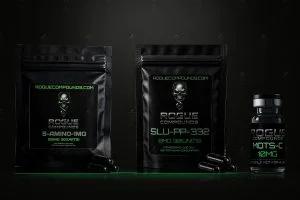 5-AMINO-1MQ CAPSULES + SLU-PP-332 + MOTS-cFrom $179.55
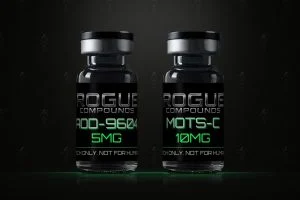 AOD-9604 + MOTS-cFrom $102.60
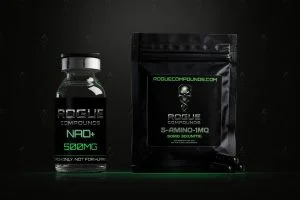 NAD+ + 5-AMINO-1MQ CAPSULESFrom $122.55