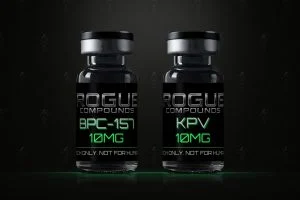

KPV and BPC-157 get compared constantly, and for one main reason: a large share of the published research on each is in models of gut inflammation. Beyond that, they have almost nothing in common. KPV is a three-amino-acid fragment of a hormone, alpha-MSH. BPC-157 is a 15-amino-acid sequence taken from a protein found in gastric juice. They differ in size, origin, the mechanisms researchers have studied, and how much of their literature comes from a single lab. This guide compares them side by side.
All compounds discussed are sold for laboratory research use only. This page summarizes published research and is not guidance for human or veterinary use.
At a glance
| KPV | BPC-157 | |
|---|---|---|
| Class | Tripeptide; C-terminal fragment of alpha-MSH (residues 11 to 13) | Synthetic pentadecapeptide based on a gastric juice protein |
| Sequence | Lys-Pro-Val | Gly-Glu-Pro-Pro-Pro-Gly-Lys-Pro-Ala-Asp-Asp-Ala-Gly-Leu-Val |
| Size | 3 amino acids, about 342 g/mol | 15 amino acids, about 1,419 g/mol |
| Best-described mechanism | Carried into intestinal cells by the PepT1 transporter, where it reduced inflammatory signaling (Dalmasso et al., 2008) | No single receptor identified; studies point to the nitric oxide system, VEGFR2 and cell migration pathways |
| Main gut models | Mouse colitis models and cultured intestinal epithelial cells | Rat models of colitis, colon ischemia and other gut injury |
| Research beyond the gut | Broader anti-inflammatory work on alpha-MSH fragments, including skin | Tendon, blood vessel and wound models |
| Who published it | A small literature from a handful of research groups | Hundreds of studies, mostly from one research group in Zagreb, Croatia |
| Regulatory status | Not FDA approved | Not FDA approved; on the WADA Prohibited List (S0) since 2022 |
Why they get compared
People searching for gut-focused research peptides tend to land on both. KPV’s best-known papers are in mouse models of colitis, and BPC-157 was developed from a stomach-protective protein and has been studied in rat models of colitis and intestinal injury. They also sit together in the KLOW blend, alongside GHK-Cu and TB-500. See GLOW vs KLOW for how that blend is put together.
The overlap ends at the research area. They are unrelated molecules from different sources, and nothing in the literature suggests they act through the same mechanism.
KPV: a small piece of alpha-MSH
Alpha-MSH is a 13-residue hormone best known for driving pigmentation through melanocortin receptors. Researchers studying its anti-inflammatory effects noticed that its last three residues, lysine-proline-valine, kept anti-inflammatory activity in several assays even without the receptor-activating core of the parent hormone (Brzoska et al., 2008; Brzoska et al., 2010).
Its most cited findings come from intestinal models:
- Uptake through PepT1: in intestinal epithelial cells, KPV was carried inside by the peptide transporter PepT1, and in mouse colitis models this uptake was linked to reduced inflammatory signaling (Dalmasso et al., 2008).
- Colitis models: a separate study found KPV reduced markers of inflammation in two mouse models of inflammatory bowel disease (Kannengiesser et al., 2008).
- Delivery research: newer work has packaged KPV in nanoparticles designed to carry it to the colon when given orally in mouse colitis models (Xiao et al., 2017).
See the KPV research overview.
BPC-157: a sequence from gastric juice
BPC stands for “body protection compound.” A research group at the University of Zagreb reported isolating a protective protein fraction from human gastric juice, and BPC-157 is a 15-residue partial sequence of it, made synthetically. Early papers described it as stable in gastric juice, which shaped its use in gastrointestinal experiments.
In the gut, the same group has studied it in rat models of colitis and of reduced blood flow to the colon, reporting effects that involved the nitric oxide system (Duzel et al., 2017), and has written about its proposed role in the gut-brain axis (Sikiric et al., 2016). Outside the gut, its best-known work is in tendon healing (Chang et al., 2011), blood vessel models (Seiwerth et al., 2014; Hsieh et al., 2017) and wound models (Huang et al., 2015). A 2025 systematic review in orthopaedic sports medicine found the evidence still largely preclinical (Vasireddi et al., 2025). See the BPC-157 research overview.
Where their research overlaps
- Gut inflammation models: both have published data in rodent colitis models, though in different species, different model designs and from different labs.
- Small, stable peptides: both are short enough to be studied for oral or local delivery, a recurring theme in each literature.
- Mostly preclinical: neither has completed controlled human trials that establish any effect.
How researchers choose between them
- Intestinal epithelial and transporter biology: KPV is the compound with published data on PepT1 uptake and epithelial inflammatory signaling.
- Tissue injury, blood flow and repair models: BPC-157 has the much larger body of work in tendon, vascular, wound and gut-injury models.
- Studying both together: because their proposed mechanisms differ, single-peptide vials let a lab test each one alone before testing them in combination or in a blend like KLOW.
- Comparing BPC-157 with other repair peptides: see BPC-157 vs TB-500.
What the research does not show
KPV’s literature is small and almost entirely in mice and cultured cells. BPC-157’s literature is large but comes mostly from one research group, and independent replication is limited. There are no studies comparing the two directly, and no controlled human data establishing safety or any effect for either. Much of what circulates online comparing them is anecdotal rather than published. Neither compound’s research supports any use outside a laboratory.
Verify what you’re working with
At about 342 and 1,419 g/mol, KPV and BPC-157 are easy to tell apart by mass spectrometry, which is how identity testing confirms what is in a vial. Every Rogue batch is tested by an independent, ISO 17025 accredited U.S. lab, and the QR code on each vial opens that batch’s report on the lab’s own website. See how to read a peptide COA or browse the COA Library.
View BPC-157 on Rogue Compounds
References
- Brzoska T, et al. Alpha-melanocyte-stimulating hormone and related tripeptides: biochemistry, antiinflammatory and protective effects in vitro and in vivo, and future perspectives for the treatment of immune-mediated inflammatory diseases. Endocr Rev. 2008;29(5):581-602. PMID 18612139
- Brzoska T, et al. Terminal signal: anti-inflammatory effects of alpha-melanocyte-stimulating hormone related peptides beyond the pharmacophore. Adv Exp Med Biol. 2010;681:107-116. PMID 21222263
- Dalmasso G, et al. PepT1-mediated tripeptide KPV uptake reduces intestinal inflammation. Gastroenterology. 2008;134(1):166-178. PMID 18061177
- Kannengiesser K, et al. Melanocortin-derived tripeptide KPV has anti-inflammatory potential in murine models of inflammatory bowel disease. Inflamm Bowel Dis. 2008;14(3):324-331. PMID 18092346
- Xiao B, et al. Orally targeted delivery of tripeptide KPV via hyaluronic acid-functionalized nanoparticles efficiently alleviates ulcerative colitis. Mol Ther. 2017;25(7):1628-1640. PMID 28143741
- Duzel A, et al. Stable gastric pentadecapeptide BPC 157 in the treatment of colitis and ischemia and reperfusion in rats: new insights. World J Gastroenterol. 2017;23(48):8465-8488. PMID 29358856
- Sikiric P, et al. Brain-gut axis and pentadecapeptide BPC 157: theoretical and practical implications. Curr Neuropharmacol. 2016;14(8):857-865. PMID 27138887
- Chang CH, et al. The promoting effect of pentadecapeptide BPC 157 on tendon healing involves tendon outgrowth, cell survival, and cell migration. J Appl Physiol. 2011;110(3):774-780. PMID 21030672
- Seiwerth S, et al. BPC 157 and blood vessels. Curr Pharm Des. 2014;20(7):1121-1125. PMID 23782145
- Hsieh MJ, et al. Therapeutic potential of pro-angiogenic BPC157 is associated with VEGFR2 activation and up-regulation. J Mol Med (Berl). 2017;95(3):323-333. PMID 27847966
- Huang T, et al. Body protective compound-157 enhances alkali-burn wound healing in vivo and promotes proliferation, migration, and angiogenesis in vitro. Drug Des Devel Ther. 2015;9:2485-2499. PMID 25995620
- Vasireddi N, et al. Emerging use of BPC-157 in orthopaedic sports medicine: a systematic review. HSS J. 2025;21(4):485-495. PMID 40756949
Compounds researchers often order together, 5% off as a set. Every vial ships with its batch COA.
See all research bundles →